A bill of sale is an important legal document used to record the transfer of ownership of personal property from one party to another. Whether you are selling a vehicle, watercraft, trailer, firearm, animal, or household item, a properly completed bill of sale provides written evidence that a transaction took place and establishes the terms agreed upon by both parties.
Table of Contents
In many private sales, verbal agreements are not enough to fully protect buyers and sellers. A bill of sale creates a clear transaction record that can help prevent disputes involving ownership, purchase price, warranties, taxes, registration requirements, and the condition of the property being sold. Financial institutions, insurance companies, state motor vehicle agencies, and law enforcement agencies may also require a bill of sale as supporting documentation.
This page provides access to downloadable and printable bill of sale forms for a wide range of transactions. Each form is designed to help individuals document a transfer of ownership accurately and professionally while maintaining a clear written record for future reference.
DEALERSHIPS: Learn how to get more customers with SEO.
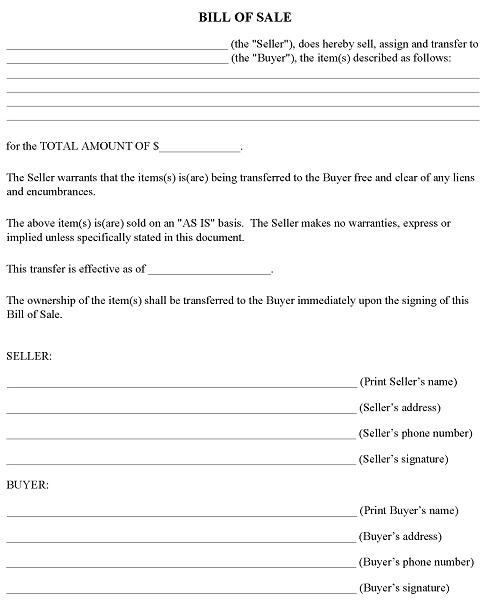
Example of Bill of Sale Form
What Is a Bill of Sale?
A bill of sale is a written agreement that documents the sale and transfer of ownership of personal property. The document identifies the buyer, seller, item being sold, purchase price, and transaction date. Depending on the type of property involved, additional information may also be required.
Most bills of sale include the following details:
- Full legal names and addresses of the buyer and seller
- Date of the transaction
- Description of the item being sold
- Purchase price
- Payment method
- Signatures of both parties
- Warranty information or “as-is” language
Some states require notarization for certain transactions, while others only require signatures. Buyers and sellers should always review their local laws to determine whether additional documentation is necessary.
Why a Bill of Sale Matters
A bill of sale serves several important purposes for both parties involved in a transaction. Without written documentation, proving ownership or verifying transaction details can become difficult if disagreements arise later.
Protection for the Seller
For sellers, a bill of sale helps establish the exact date ownership was transferred to the buyer. This can be especially important when selling vehicles, boats, trailers, or equipment that may later become involved in accidents, fines, registration violations, or legal disputes.
The document may also protect the seller from future liability after the item has changed ownership. Including “sold as-is” language can clarify that the buyer accepted the item in its current condition without guarantees beyond those specifically stated in writing.
Protection for the Buyer
Buyers benefit from having written proof that they legally purchased the property. A bill of sale may help confirm ownership during registration, insurance applications, financing, tax reporting, or title transfer procedures.
In some cases, buyers may also need a bill of sale to demonstrate the purchase value of an item for tax or legal purposes. Having a signed document helps verify that the transaction occurred under mutually agreed terms.
Common Types of Bill of Sale Forms
Bills of sale can be used for many different types of personal property transactions. Some of the most commonly used forms include:
- Automobile bill of sale
- Boat bill of sale
- Trailer bill of sale
- Motorcycle bill of sale
- RV bill of sale
- ATV bill of sale
- Firearm bill of sale
- Animal bill of sale
- Equipment bill of sale
- Furniture bill of sale
- Bicycle bill of sale
- Camper bill of sale
Each type of bill of sale may contain transaction-specific fields intended to capture details relevant to that category of property.
Automobile Bill of Sale
An automobile bill of sale is one of the most frequently used sales documents in private-party transactions. This legal document records the transfer of ownership of a motor vehicle from the seller to the buyer and may be required by state motor vehicle agencies during title and registration procedures.
A properly completed automobile bill of sale generally includes:
- Vehicle year, make, and model
- Vehicle Identification Number (VIN)
- Odometer reading
- Purchase price
- Sale date
- Buyer and seller information
- Signature of both parties
Some states also require odometer disclosures, emissions documentation, or title assignment forms in addition to the bill of sale.
When purchasing a used vehicle, buyers should carefully inspect the automobile, verify the VIN matches the title, and review any existing liens before completing the transaction. Sellers should retain copies of all signed documents for their records.
An automobile bill of sale can help establish proof of purchase, clarify ownership transfer dates, and reduce misunderstandings regarding the condition and terms of the sale.
Boat Bill of Sale
A boat bill of sale is used to document the sale and transfer of ownership of a watercraft between parties. In many states, this legal document is required for registration and titling purposes through the appropriate boating or natural resources agency.
Boat bill of sale forms commonly include:
- Boat make and model
- Hull Identification Number (HIN)
- Registration number
- Year of manufacture
- Purchase price
- Buyer and seller details
- Motor information if included
- Trailer details if applicable
Because boats are often sold together with trailers and outboard motors, the bill of sale may need to separately identify each item included in the transaction. This helps avoid confusion regarding ownership of attached equipment.
Buyers should verify that all registration and title documents are accurate before completing payment. Sellers should disclose any known damage, liens, or operational issues to avoid future disputes.
A boat bill of sale provides an official transaction record that may help establish legal ownership, support insurance applications, and simplify future resale transactions.
Correctly Using a Bill of Sale
Completing a bill of sale accurately is essential. Missing information or incomplete descriptions may create problems later if questions arise regarding the transaction.
To properly complete a bill of sale:
- Use full legal names for all parties involved.
- Provide a detailed description of the item being sold.
- Include identifying numbers when applicable.
- Clearly state the purchase amount.
- Specify whether the property is sold “as-is.”
- Have both parties sign and date the document.
- Make copies for both buyer and seller.
In some situations, notarization may provide additional legal protection, even when not legally required.
Requirements Vary By State
Bill of sale requirements can differ significantly depending on the state and type of property involved. Some states require bills of sale for vehicle registration, while others may only require title transfer documents.
Certain states may also require:
- Witness signatures
- Notarization
- Odometer disclosures
- Sales tax forms
- VIN inspections
- Registration applications
Users should always verify local requirements with their state motor vehicle department or applicable licensing agency before finalizing a transaction.
Important Legal Considerations
Although a bill of sale is an important legal document, it does not automatically replace title transfer requirements where titles are legally required. Buyers should ensure that all supporting ownership documents are properly completed and transferred.
Additionally, a bill of sale does not guarantee the condition of an item unless specific warranties are included in writing. Many private sales are completed on an “as-is” basis, meaning the buyer accepts the property in its present condition.
If the transaction involves high-value property, unusual circumstances, inherited assets, or disputed ownership issues, consulting a licensed attorney may be advisable.
Printable and Downloadable Bill of Sale Forms
Using a professionally prepared bill of sale form can help ensure important information is not overlooked during a transaction. Printable templates provide a convenient way for buyers and sellers to create organized records while helping maintain compliance with state documentation requirements.
Whether you are selling a vehicle, purchasing a boat, transferring equipment, or documenting the sale of personal property, a properly completed bill of sale can help protect both parties and provide valuable legal documentation for years to come.
Browse the available bill of sale forms to find the document that best matches your transaction needs.
Bill of Sale Forms By Type
Boat & Trailer Bill of Sale Form
Boat Trailer Bill of Sale Form
Camper Trailer Bill of Sale Form
Cargo Trailer Bill of Sale Form
Commercial Truck Bill of Sale Form
Electric Scooter Bill of Sale Form
Farm Equipment Bill of Sale Form
Farm Tractor Bill of Sale Form
Four Wheeler Bill of Sale Form
Heavy Equipment Bill of Sale Form
Horse Trailer Bill of Sale Form
Lawn Equipment Bill of Sale Form
Manufactured Home Bill of Sale Form
Motor Vehicle Bill of Sale Form
Outboard Motor Bill of Sale Form
Side by Side Bill of Sale Form
Tractor Trailer Bill of Sale Form
Travel Trailer Bill of Sale Form
Utility Trailer Bill of Sale Form
Vessel Trailer Bill of Sale Form

Bill of Sale Form Frequently Asked Questions
A notarized bill of sale is not a type of document. In order for the form to be notarized, it must be signed and dated by a notary public. The notary should also stamp the document with his or her notary seal. Most notaries charge under $10 for this service, although we’ve heard that in some cities the fees can be insanely expensive. Notary publics are self-employed and can charge whatever they want for the service.
In most cases the only way to obtain a duplicate copy of the original bill of sale is to contact the person from whom you purchased the item. Sellers are not required to keep a copy of the bill of sale, but many do. Bills of sale are not considered court documents so it’s doubtful any government agency will have a copy on file. Your best bet is to contact the seller. Even if the seller didn’t keep a copy of the original bill of sale, he or she may be willing to create a new one for you both to sign.
Do not sign the bill of sale until both parties are ready to transfer ownership of the item. Normally this is when the buyer forwards payment to the seller. Sellers should not sign the bill of sale until they have payment in hand. Buyers should not sign the bill of sale until they receive the property being purchased.
Of course you can. Be sure to include your name, the buyer’s name, the date, sales price, and a detailed description of the item being sold. If the item being sold is a motor vehicle, boat, or other item that must be registered with the state, you must include all information such as the make, manufacturer, model, ID number, and year of manufacture. For motor vehicles you must also include the mileage on the odometer.
The best option is to create two bills of sale. Give one original bill of sale to the buyer, and keep the other original for yourself. You could sign one form and make a copy but the best option is to prepare and sign two separate originals.
As the seller, it is imperative that you verify the buyer’s identity and retain a copy of the bill of sale. Let’s say you sell a car. Two hours later the police knock on your door and inform you that the car hit a pedestrian and left the scene of the accident. You’d better hope you have a copy of the bill of sale to prove you sold that vehicle!