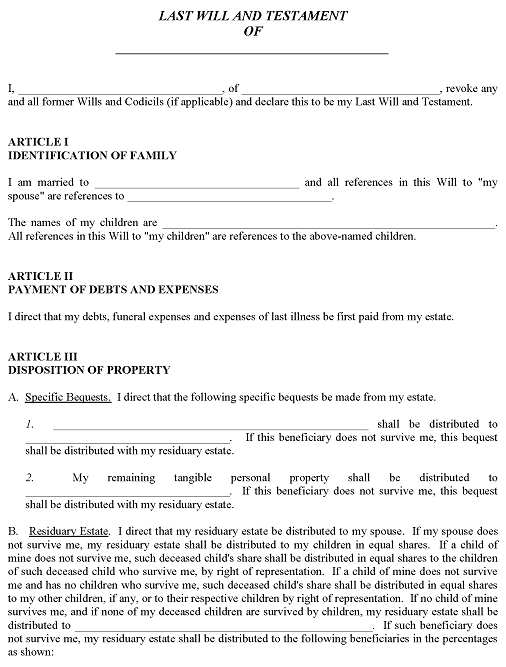
The Kentucky last will and testament, also known as a will, is a legal document that details the testator’s wishes regarding the distribution of their assets, the upbringing of their children, and other matters after their passing. A personal representative, also known as an executor, is a responsible individual appointed to oversee the distribution of the estate in compliance with the terms of the will.
Table of Contents
A Kentucky Last Will and Testament is a legal document that allows a person (called the testator) to declare how they want their property, assets, and responsibilities to be distributed after their death. It also allows the testator to:
- Appoint an executor (someone to manage the estate and carry out the terms of the will).
- Name guardians for minor children.
- Make specific gifts or bequests to individuals or organizations.
- Provide instructions for the care of pets or other dependents.
Last Will and Testament Requirements in Kentucky:
To be valid under Kentucky law, a Last Will and Testament must meet these conditions:
- Age and Mental Capacity:
- The testator must be at least 18 years old.
- They must be of sound mind.
- Written Form:
- It must be in writing (typed or handwritten).
- Kentucky also recognizes holographic wills (entirely handwritten and signed by the testator) without witnesses.
- Signature:
- The testator must sign the will or direct someone to sign it in their presence.
- Witnesses:
- If not holographic, the will must be signed by at least two competent witnesses who saw the testator sign or heard them acknowledge the will.
- Notarization:
- Not required, but a self-proving affidavit (signed in front of a notary by the testator and witnesses) can make probate faster and easier.
Why Having a Kentucky Last Will and Testament is Important:
- Ensures your wishes are followed.
- Helps avoid family disputes.
- Simplifies the probate process.
- Allows you to control who gets what and when.
What Happens in Kentucky if You Die Without a Will?
If someone dies without a will (intestate), Kentucky law determines how the estate is divided, usually among surviving spouses, children, or other relativesâregardless of the your actual wishes. This is why it’s imperative that you sign a last will and testament.
State Statute Governing Kentucky Wills
Kentucky Revised Statutes Chapter 394
Kentucky Definition of Will
“Will” means a last will or testament, codicil, appointment by will, writing in the nature of a will in exercise of a power, and any other testamentary disposition. 1
Kentucky Will Age Requirements
Age Requirements: Any person of sound mind and eighteen (18) years of age or older may create a will. Minors under 18 may create a will, but only to appoint a guardian for his child. 2
Kentucky Will Witness Requirements
Will Witnessing Requirements: At least two (2) credible witnesses, who shall subscribe the will
with their names in the presence of the testator, and in the presence of each other.
Revoking A Kentucky Will
A Kentucky last will and testament may be revoked by 1) a subsequent will or codicil, 2) by some writing that indicates the testator’s intention to revoke the will, or 3) by the testator or someone else at his direction, destroying the will.
Example of Kentucky Last Will and Testament