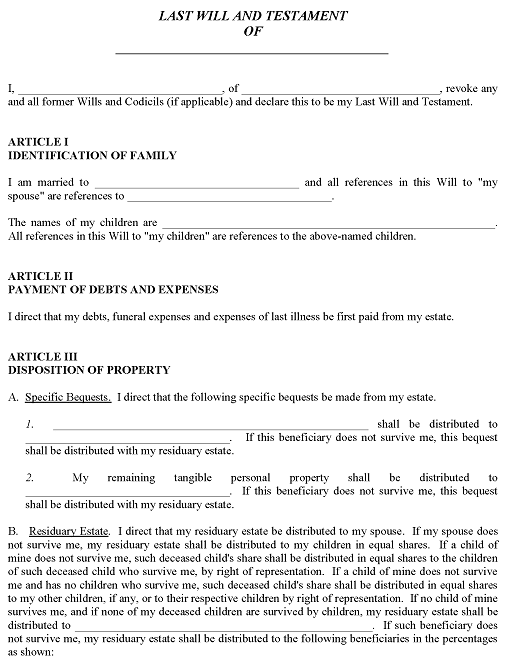
The Florida last will and testament, commonly referred to as a will, is a legal document that expresses the testator’s desires for the allocation of their possessions, the raising of their heirs, and other issues after their death. An executor, another name for a personal representative, is a responsible person designated to supervise the distribution of the estate in accordance with the will’s provisions.
Table of Contents
Key Elements of a Florida Last Will and Testament
- Testator’s Information – Full name, address, and declaration of mental competence.
- Revocation of Previous Wills – Any earlier wills are usually revoked by the new one.
- Beneficiaries – People or organizations who will inherit property.
- Specific Bequests – Gifts of specific property or amounts of money to named individuals.
- Residue Clause – Instructions for distributing any remaining assets.
- Personal Representative – The person appointed to carry out the terms of the will.
- Guardianship – Appointment of a guardian for minor children, if applicable.
- Execution – Signed by the testator and two witnesses in the presence of each other (as required under Florida law).
Florida Last Will and Testament Requirements
- The testator must be at least 18 years old and of sound mind.
- The will must be in writing (oral wills are not recognized).
- It must be signed by the testator (or by someone else at the testator’s direction and in their presence).
- It must be witnessed by two people, who also sign in the presence of the testator and each other.
Self-Proving Wills:
- Self-Proving Affidavit – A notarized document signed by the testator and witnesses that simplifies the probate process.
Why Having a Florida Last Will and Testament is Important:
Having a valid Florida will:
Makes probate more efficient.
Ensures your assets go where you want.
Avoids intestate succession (where state law decides who inherits).
Helps reduce family disputes.
Florida Will Age Requirements
Age Requirements: Any person who is of sound mind and who is either 18 or more years of age or an emancipated minor may make a will. 1
Will Signing Requirements
Will Signing Requirements: The testator must sign the will at the end or the testator’s name must be subscribed at the end of the will by some other person in the testator’s presence and by the testator’s direction. 2
Florida Will Witness Requirements
Will Witnessing Requirements: At least two persons each of whom witnessed either the signing or the testator’s acknowledgment of the signature or of the will. Any person competent to be a witness may act as a witness to a will. The will or codicil, or any part of either, is not invalid because the will or codicil is signed by an interested witness. 3
Florida Self-Proved Wills
Florida allows self-proved wills. A will or codicil executed in conformity with state statute may be made self-proved at the time of its execution or at any subsequent date by the acknowledgment of it by the testator and the affidavits of the witnesses, made before an officer authorized to administer oaths and evidenced by the officer’s certificate attached to or following the will.
Revoking a Florida Will
A Florida will can be revoked by subsequent will, by codicil, or by the testator destroying it.
Summary of Florida Will Requirements
Anyone 18 years of age or older, or any emancipated adult, can write and sign a will in Florida. The will should be witnessed by two persons. The will is not considered to be invalid if the witnesses are named as beneficiaries in the will. If the will is notarized, it is considered to be self-proved.
Example of a Florida Last Will and Testament