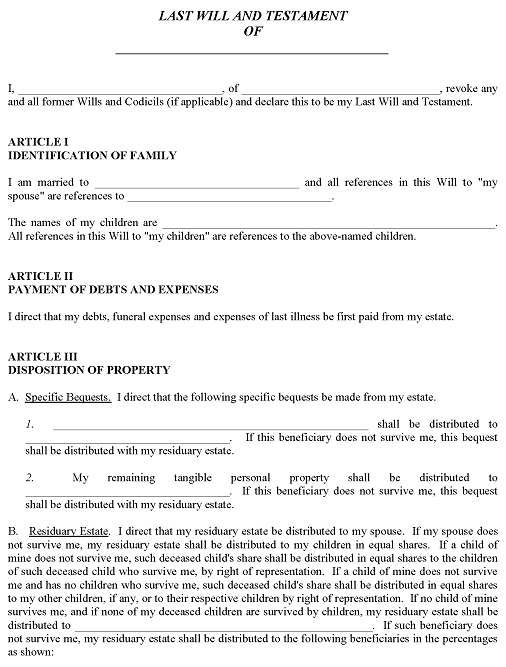
The California last will and testament, which is a legal document, gives an individual called the testator the ability to choose how their estate will be distributed when they pass away. Businesses, digital assets, real land, personal property, life insurance policies, and all other assets and property may be distributed by the will.
Table of Contents
Elements of a California Last Will and Testament:
- Distribute Property
Designate who (beneficiaries) receives your money, property, and other assets. - Name an Executor
Appoint someone to manage your estate—pay debts, file taxes, distribute assets, etc. - Appoint a Guardian
If you have minor children, name someone to care for them. - Make Specific Gifts
Leave particular items (jewelry, cars, heirlooms) to specific people. - Include Residuary Clauses
State what happens to any remaining assets not explicitly mentioned.
Requirements for a Valid Will in California:
Under California Probate Code, to be valid:
- Age & Mental Capacity: You must be 18+ and of sound mind.
- In Writing: It must be typed or handwritten.
- Signed: By you (the testator) and two witnesses, who also sign at the same time.
- Witnesses: Cannot be people receiving gifts in the will (to avoid conflicts of interest).
California also allows holographic wills (entirely handwritten), even without witnesses, but they must show clear intent and be signed and dated by the testator.
Will Probate Process
- The will is submitted to the probate court in the county where the testator lived.
- The court ensures the will is valid and oversees the administration of the estate.
Why Having a California Last Will and Testament is Important
- Protect minor children and dependents
- Avoid family disputes
- Ensure your wishes are respected
- Speed up the legal process
California Will Signing Requirements
Will Signing Requirements: The will shall be in writing by the testator, in the testator’s name by some other person in the testator’s presence and by the testator’s direction, or by a conservator pursuant to a court order to make a will.1
California Will Witness Requirements
Will Witnessing Requirements: At least two persons each of whom is present at the same time, and witnessed either the signing of the will by the testator or the testator’s acknowledgment of the signature or of the will.
Revoking A California Will
A California will can be revoked by creating a subsequent will, by codicil or by the testator destroying it by burning, tearing, cancelling, obliterating, or destroying the will, with the intent and for the purpose of revoking it by the testator or by another person in his presence by his consent and direction. If the physical act is by someone other than the testator, consent and direction of the testator there must be at least two witnesses present. 2
Summary of California Will Requirements
Anyone 18 years of age or older and of sound mind can write and sign a will in California. The will should be witnessed by two persons having no financial interest in the will. With the proper court order, a conservator may also create a will on behalf of the testator.
Example of a California Will