A Boat and Trailer Bill of Sale is a legally significant document used to record the transfer of ownership of a boat and its accompanying trailer from a seller to a buyer. This document serves as written proof that the transaction occurred and establishes the terms and conditions agreed upon by both parties. Whether the vessel is being sold privately, transferred between family members, or included as part of a larger recreational vehicle transaction, a properly completed bill of sale helps protect the legal and financial interests of everyone involved.
Table of Contents
Unlike a simple receipt, a Boat and Trailer Bill of Sale contains detailed information regarding the property being transferred. It identifies the buyer and seller, describes the boat and trailer in precise terms, states the purchase price, and documents the date of sale. Many states require this form when registering a boat or trailer with the appropriate motor vehicle or marine authority. Without a properly executed bill of sale, buyers may encounter delays or complications when attempting to obtain registration, title documentation, or proof of lawful ownership.
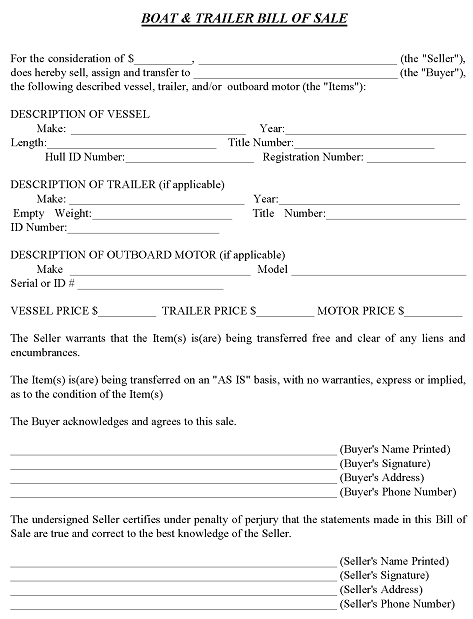
Example of Boat and Trailer Bill of Sale Form
Why a Boat and Trailer Bill of Sale Is Important
A properly drafted bill of sale creates a clear legal record of the transaction. This documentation can help prevent disputes regarding ownership, payment terms, included equipment, or the condition of the property at the time of sale. For buyers, the form establishes evidence that ownership was legally transferred. For sellers, it provides proof that responsibility for the boat and trailer passed to another party on the specified date.
Boat and trailer sales often involve significant financial value. In many cases, the transaction includes additional equipment such as motors, navigational electronics, life jackets, anchors, or storage covers. Including these items in the bill of sale reduces confusion and ensures all parties understand exactly what is included in the purchase.
The document may also be necessary for tax purposes. State agencies frequently use the stated purchase price to determine applicable sales taxes, registration fees, or title transfer costs. Providing accurate information helps avoid future legal or financial complications.
Information Commonly Included in the Form
A comprehensive Boat and Trailer Bill of Sale should contain complete and accurate information about the transaction. Typical details include:
- Full legal names and addresses of the buyer and seller
- Date of the sale
- Purchase price and payment method
- Description of the boat, including:
- Manufacturer
- Model
- Year
- Hull Identification Number (HIN)
- Length
- Registration number
- Description of the trailer, including:
- Manufacturer
- Model
- Year
- Vehicle Identification Number (VIN)
- License plate number, if applicable
- Description of any included outboard motors or accessories
- Odometer disclosure for the trailer if required by state law
- Signatures of both parties
- Notarization, when required or recommended
Accuracy is essential when completing the form. Errors involving identification numbers, names, or purchase amounts can create registration problems or delay title transfers.
State Requirements May Vary
Boat and trailer ownership laws differ from state to state. Some states require separate titles for the boat, trailer, and motor, while others combine certain components into a single registration process. In some jurisdictions, notarization is mandatory before the bill of sale will be accepted by government agencies.
Buyers and sellers should verify the requirements established by their state’s department of motor vehicles, wildlife agency, or boating authority before finalizing the transaction. Using a form that complies with local regulations can help ensure the transfer process proceeds smoothly.
Additionally, some states require disclosure of liens or outstanding loans attached to the property. Sellers should confirm that all financing obligations have been satisfied before completing the transfer. Buyers should also verify title status to avoid assuming responsibility for undisclosed debts.
Selling a Boat and Trailer “As-Is”
Many private sales are completed on an “as-is” basis. This means the buyer accepts the boat and trailer in their current condition, with no warranties expressed or implied by the seller. Including an “as-is” clause in the bill of sale helps clarify that the seller is not guaranteeing future performance or condition.
Even when an item is sold as-is, sellers should remain truthful regarding known defects or major issues. Misrepresentation during a private sale can still lead to legal disputes. Buyers are encouraged to inspect the boat, trailer, motor, and related equipment carefully before completing the purchase.
For higher-value transactions, buyers may wish to obtain a marine survey or professional inspection. This can reveal structural damage, engine issues, trailer defects, or other concerns that may not be immediately visible.
Benefits of Maintaining Proper Documentation
Maintaining detailed records benefits both parties long after the sale is complete. A signed bill of sale can help establish:
- Legal ownership history
- Tax documentation
- Registration eligibility
- Proof of payment
- Liability transfer date
- Equipment inventory
Sellers should keep a copy of the completed form for their personal records. Buyers should store the document in a secure location alongside registration paperwork, title documents, and insurance records.
Digital copies may also be useful in case the original document is lost or damaged. Proper recordkeeping can simplify future resale transactions and help resolve disputes if questions arise regarding ownership history.
When to Use a Boat and Trailer Bill of Sale
This form should be used whenever ownership of a boat and trailer changes hands, including:
- Private party sales
- Family transfers
- Gift transactions
- Trade agreements
- Estate distributions
- Partial ownership buyouts
Even when a transaction occurs between trusted individuals, written documentation remains essential. Verbal agreements alone often fail to provide adequate legal protection if disagreements occur later.
Final Considerations
A Boat and Trailer Bill of Sale is more than a simple transaction record. It is an important legal document that helps establish ownership rights, supports registration requirements, and protects both buyers and sellers from unnecessary disputes. Completing the form accurately and thoroughly can save substantial time, expense, and legal difficulty in the future.
Before signing the document, both parties should carefully review all information for accuracy and completeness. If the transaction involves substantial value, complex ownership issues, or uncertainty regarding state requirements, consulting a qualified attorney or registration professional may be advisable.
Using a professionally structured Boat and Trailer Bill of Sale helps ensure the transaction is properly documented and legally defensible, providing clarity and confidence for all parties involved.

Boat & Trailer Bill of Sale Forms
Microsoft Word
Boat and Trailer Bill of Sale Form Word